 hseipaa.kz




Audit inspection
An independent review of financial statements, the internal control system and key business risks, with clear conclusions and practical recommendations for management.
 Review according to an agreed plan
 Team of practising auditors
 Audit report and opinion based on the results of the audit

0
When an audit is needed
An audit is carried out not only when required by law. A review is also useful in other cases when it is important for the owner to understand the real state of the company's accounting and finances.

Preparation for a tax audit

Review of the state of financial management

Review of customer relationship management
What you get as a result of the audit
 General audit opinion on financial statements
A report with the issues identified during the audit and ways to resolve them
Letter to management with recommendations
The company's risk map
List of correcting entries with explanations
Analysis of taxation issues
An assessment of the state of the internal control system
Advantages of working with us
Organisation and conduct of audits by highly qualified specialists, as well as training and workshops for auditors.

Professional expertise
The audit is carried out by experienced auditors and finance specialists.

Independent assessment
We draw objective conclusions on the state of accounting and reporting.

Risk identification
We identify financial, tax and operational risks before losses occur.

Practical recommendations
We propose specific measures to eliminate identified violations.

Confidentiality
We ensure the protection of the client's documents and information.

Clear result
We provide a structured report with conclusions and priorities.
What is needed to start the audit
Preparation takes minimal time if you collect the main data in advance.

Access to documents
Accounting registers and primary documentation

Financial reporting
Reporting for the period under review

Contact person
A contact person for the audit team

Agreeing deadlines
Approved plan and review stages
Who the audit is suitable for
For companies subject to mandatory audit
For businesses ahead of a tax audit
For owners when management changes
For companies with external investors
For organisations ahead of a deal or a loan
Stages of an audit
In practice, an audit can be broadly divided into a number of successive stages — from analysing the company's activities to summing up the results together with management.

8 stages
The audit is conducted according to a clear and pre-agreed plan.

Risk map
We compile a list of areas requiring constant control.

Final meeting
We discuss the results and decisions together with management.
- detailed analysis of activities and identification of areas where failures and violations are likely
- agreeing stages and drawing up a working plan for the audit
- assessment of market conditions and of business and audit risk factors
- studying internal audit reports in order to focus on the important areas
- formation of the company's risk map across key areas
- carrying out all planned and agreed audit activities
- preparing the opinion, managing audit risks and supplements to the reporting
- discussion of the reporting, the management letter and the list of adjusting entries
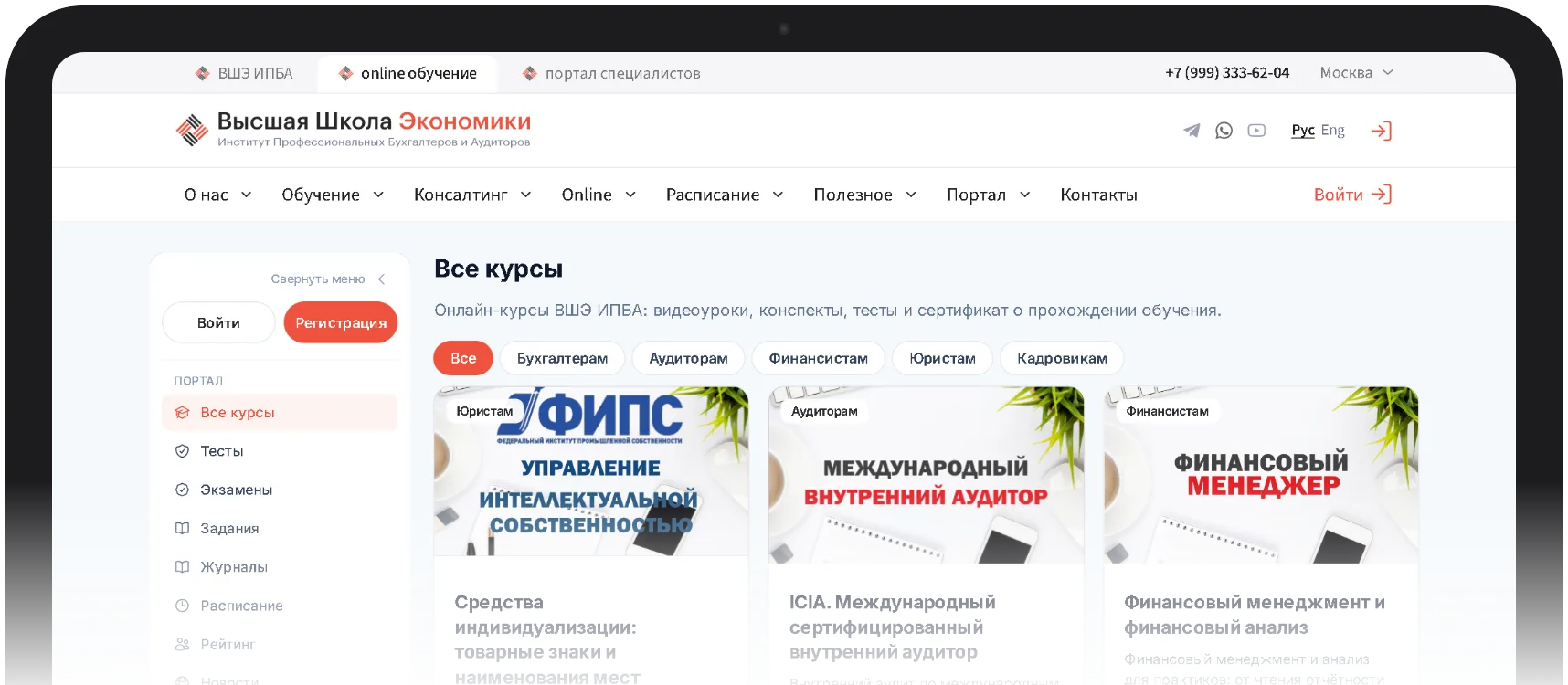
A convenient learning platform
A personal account with a clear interface: manage your training, track your progress and communicate with instructors in one place.
Training materials
All lectures, presentations and assignments in one place
Class schedule
A calendar with reminders of upcoming classes
Progress
Progress and completed assignments
Video lectures
Watch lectures at a convenient time
FAQ
Frequently asked questions about the Audit service
Didn't find an answer? Ask a question — a manager will reply and help you choose a program.
Ask a question01 What does the «Audit» service include?
The scope of work is determined after analysing the client's task. We agree on the stages, expected result, timing and list of required documents, and then record them in the proposal.
02 Who is this service suitable for?
The service suits companies and entrepreneurs that need professional support in the "Audit" area without expanding their own team.
03 How is the project work organised?
Work begins with a consultation and diagnostics. We then draw up a plan, assign responsible specialists, carry out the agreed stages and deliver the results to the client.
04 What do timelines and cost depend on?
Timing and cost depend on the scope of work, the condition of the source data, the complexity of the task and the required depth of support. Exact terms are determined after an initial assessment.
05 How is confidentiality ensured?
The client's information and documents are used only to carry out the agreed work. Access to them is granted to the specialists directly involved in the project.
About the “Audit” service
Organisation and conduct of an audit by highly qualified specialists. Training and workshops for auditors. Professional and accessible.
Organisation and conduct of an audit
For many, an audit is a rarity or a necessity dictated by legal requirements, but, in the opinion of the Higher School of Economics, an audit can also be carried out in other cases:
- Checking the correctness of accounting in the company
- Preparing for a tax audit
- Reviewing the state of financial management
- Reviewing customer relationship management
Stages of an audit
In practice, an audit can be conditionally divided into a number of stages.
1. Analysis of the audit object and formation of the team.
A detailed analysis of the activities will make it possible, at the initial stage, to identify the areas where failures and malfunctions are most likely to occur.
2. Negotiations and agreement of the stages of the audit.
Drawing up the working plan of the audit
3. Analysis of the business environment and market conditions
It is necessary to gain an understanding of market conditions, the business environment, the goals of the business and the shareholders who influence the client's business risk and, accordingly, the audit risk associated with it.
4. Analysis of the state of internal audit.
Holding a meeting and analysing internal audit reports will save time on carrying out the main audit and allow you to concentrate on the important stages of the audit.
5. Drawing up the risk map.
A risk map is a mandatory attribute of every company. When drawing up a risk map, many necessary areas that require constant monitoring can be taken into account
6. Carrying out audit procedures.
The actual performance of all the planned and agreed audit activities.
7. Preparing the audit report.
It is necessary to summarise the results of the audit, which at a minimum includes:
discussion and resolution of significant issues identified during the audit;
settlement of all audit risks identified during the planning and the assessment of internal controls; a description of the adjustments that must be made to the client's financial statements;
carrying out an overall analytical review of the financial statements; preparing the overall audit opinion.
8. Summing up.
To complete and sum up the audit effectively, it is necessary to hold a meeting with the participation of the relevant employees of the client and members of the project team. At this meeting the following should be discussed and analysed:
- draft financial statements;
- the management letter;
- issues identified during the audit and ways of resolving them;
- tax issues;
- unresolved problems (if any).
By the end of the meeting, all the persons concerned should reach a common understanding of these issues. In addition, at the meeting the client must be presented with the finally approved list of correcting entries with the necessary explanations and calculations, as well as explanations on the transformation of statements prepared under Russian standards into statements prepared under international accounting standards. It is best to hold such a meeting before the opinion is signed and issued.
Not sure which program to choose?
Our specialists will help you choose a program for your goals and answer all your questions. The consultation is free!
Reach us in one click: call us.
+7 (727) 224-21-21
contact us via messengers


