 hseipaa.kz




Tax Consultant
Comprehensive training of expert-level tax consultants. The course helps you work confidently with the legislation of the RK, assess tax risks, find lawful solutions for business and support the client during inspections and disputes.
 Days and time by agreement
 4 blocks, 13 topics
 Qualification certificate "Tax Consultant of the RK"
317 500 ₸
/course
250 000 ₸
/course
“Online” — go to online learning: find a course, buy it and start right away

0
Who is a tax consultant
The tax legislation of the RK is complex and constantly changing. A Tax Consultant helps you pay taxes correctly, optimise payments lawfully, prevent errors and penalties, and, if necessary, represent the client's interests in court.

Working with business, not with forms

Tax planning and optimisation

Participation in a tax audit
What you will get after the training
 Qualification certificate "Tax Consultant of the RK"
Training certificate (certificate)
Verification of the document's legitimacy against the database on the site
Expert-level competencies on the Tax Code 2026
Skill in managing the tax base and VAT risks
Understanding desk-based and comparative control
A strategy for lawful tax optimisation
Why the profession is in demand
The 2026 reform has made independent calculation of taxes and deductions almost impossible even for large holdings.

Three career options
Work in a consulting firm, on a company's staff or in private practice.

Guarantee of training quality
The programme is based on the current Tax Code and case law.

Flexible format
Individual, corporate and distance training in groups of 4–15 people.
Organisation of training
The format and schedule are selected to suit the learner or the company.

Formats
Individual, corporate and remote.

Duration
According to the schedule and by agreement of the parties.

Group
A group of 4–15 people is formed.

Document
Qualification certificate "Tax Consultant of the RK".
Who the training is suitable for
For lawyers and advocates on fiscal legislation
For economists
For accountants and chief accountants
For chief financial officers
For employees of consulting companies
For entrepreneurs
For those planning private practice
"Tax Consultant" training programme
Four blocks: the profession, changes in legislation in 2026, administration and control, expertise and income.

250 000 ₸
cost of training

13
programme topics

4–15
people per group
- Role, status and responsibility, growth strategy, the logic of the tax system of the RK.
- Overview of the Tax Code 2026, tax regimes, VAT, corporate income tax, payroll taxes and local payments.
- Desk and comparative audits, application of the MLI, corporate income tax and VAT for a non-resident.
- Current 2024–2026 cases on VAT, corporate income tax and transactions with non-residents.
- Developing a consultant's personal brand and AI as a working tool.
Course price
250 000 ₸

Learn now, pay later!
30 427
₸/mo
23 958
₸/mo
Installments for 12 months
15%
Enroll in the course or get a free consultation
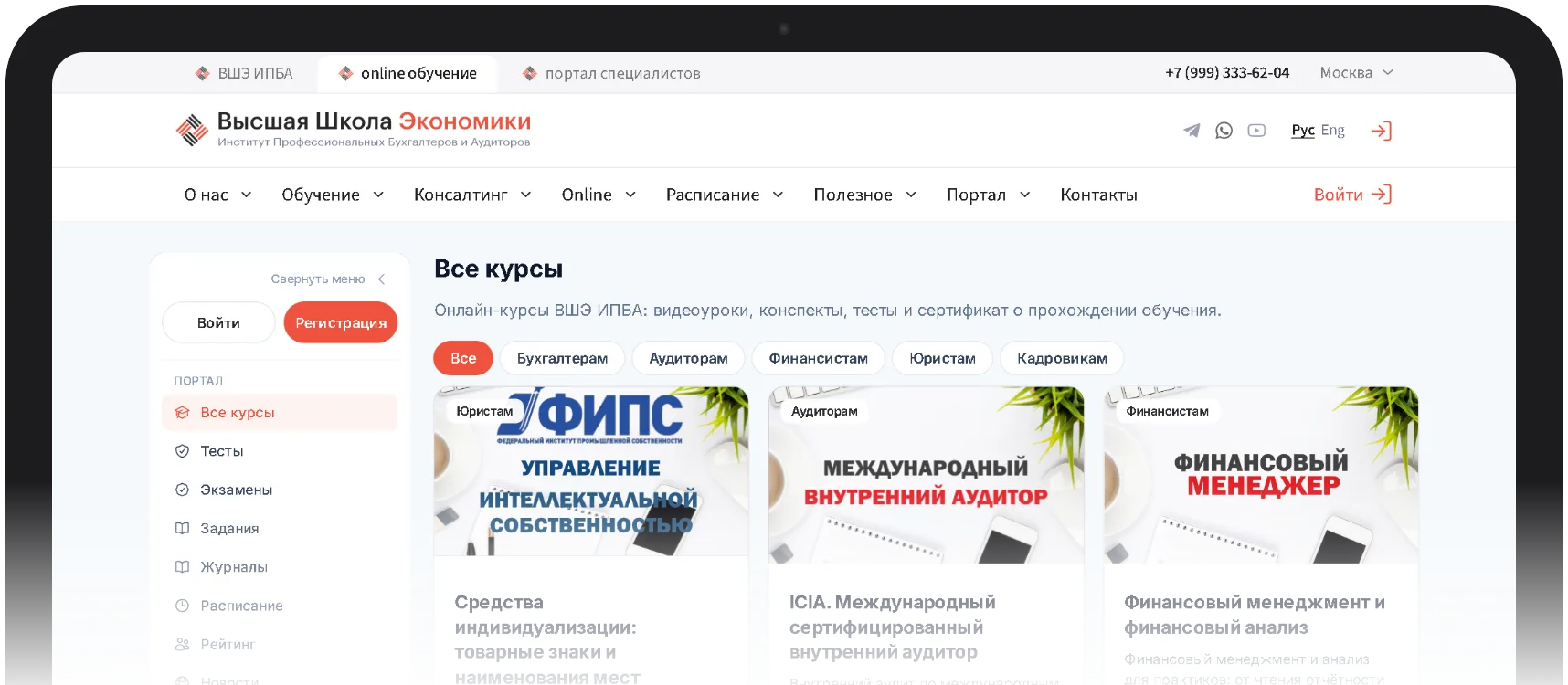
A convenient learning platform
A personal account with a clear interface: manage your training, track your progress and communicate with instructors in one place.
Training materials
All lectures, presentations and assignments in one place
Class schedule
A calendar with reminders of upcoming classes
Progress
Progress and completed assignments
Video lectures
Watch lectures at a convenient time
FAQ
Frequently asked questions about the «Tax Consultant» course
Didn't find an answer? Ask a question — a manager will reply and help you choose a program.
Ask a question01 Who is the «Tax Consultant» course for?
The course is suitable for specialists who need to systematise their knowledge of “Tax Consultant”, improve their professional qualifications and apply the skills acquired in their work.
02 What does the course programme include?
The programme covers key requirements, professional tools and practical aspects of the course topic — training expert-level tax consultants.
03 Are practical classes included?
Yes. Theoretical material is reinforced with practical assignments, examples and professional situations so that learners can confidently apply their knowledge at work.
04 What are the duration and format of the training?
Format of training: Days and time by agreement. Duration: 4 blocks, 13 topics.
05 What document is issued after the training?
After successful completion of the course, the learner is issued with the Qualification Certificate “Tax Consultant of the RK”. The conditions of the final assessment are communicated before classes begin.
Course price
250 000 ₸
Learn now, pay later!
30 427
₸/mo
23 958
₸/mo
Installments for 12 months
15%
Enroll in the course or get a free consultation
About the “Tax Consultant” program
Training of tax consultants
Tax legislation has a complex structure and is constantly amended, which makes life difficult for business: not only individuals but also large companies often cannot calculate the amount of a tax or deduction on their own. They need the help of a specialist, and this makes the profession of tax consultant in great demand, especially in the business environment.
The consultant's task is to help the client understand how to pay taxes and, where possible, to optimise the amount of payments. A tax consultant helps prevent mistakes and the related penalties, and if necessary represents the client's interests in court. As a rule, tax consultants are lawyers or advocates who specialise in fiscal legislation, as well as economists.
You can choose one of three employment options:
1) In a general-practice law firm or a company specialising in taxes. The advantage of such work is that it is team-based and the firm finds the clients.
2) Working on the staff of a commercial company. In this case the consultant has only one client, whose specifics they know thoroughly.
3) Private practice. Here, as a rule, you first have to work in a law firm in order to build a client base that will bring a steady income. Private practice makes it possible to work in your own mode and to receive fees rather than percentages.
Today, close, constructive cooperation between all participants in tax legal relations depends largely on the tax consultant. The tax consultant acts as a qualified intermediary between the tax authority and the taxpayer. Life itself has forced the interests of both parties to be taken into account, since only civilised relations based on mutual understanding can deliver the necessary result. A tax consultant is a specialist of a very high class. To obtain this profession, it is not enough simply to graduate from university. You need to complete a programme of additional education and then improve your qualifications throughout your life.
Features of the profession
A tax consultant advises clients (legal entities and individuals) on taxation, and also:
- explains the practice of applying the legislation on taxes and levies;
- helps legal entities and individuals with tax optimisation issues;
- prevents errors related to incorrect calculation and late payment of taxes;
- assists in organising and maintaining tax accounting;
- represents and defends the interests of taxpayers in courts and other bodies;
- provides services for legal review of a taxpayer's documents.
Tax consulting is a borderline field between law and economics. Qualified lawyers and economists have a huge advantage: they understand the tax system and possess specialist knowledge. Depending on the place of work, tax consultants also perform other functions: they develop methodological materials and recommendations for clients, take part in tax audits, prepare articles and materials for publication in various media, and participate in projects related to tax planning and optimisation.
TRAINING QUALITY GUARANTEE!
During the training, participants will learn:
They will strengthen their knowledge of tax accounting
Training format:
- Individual
- Corporate
- Distance
Duration:
- According to the schedule and / or by agreement of the parties
Group formation:
- 4-15 people
Cost of training:
- Depends on the training format (please check with our managers)
Additional information:
- Days and times by arrangement
Qualification document issued:
- Training certificate (Certificate)
The profession of "Tax Consultant" - training and career prospects in 2026
The tax legislation of Kazakhstan has a complex structure and is subject to constant change. The 2026 reform has made independent calculation of taxes and deductions practically impossible not only for individuals but also for large holdings. This has put the profession of tax consultant among the most in-demand specialities in the business environment.
The role and tasks of a tax consultant
- A tax consultant is a qualified intermediary between the tax authority and the taxpayer.
- Their task is not merely to explain the rules, but to create civilised, constructive relations between the state and business.
The expert's main functions:
- Helping to understand the mechanisms of paying taxes and to lawfully reduce the tax burden.
- Preventing errors in calculating and paying taxes, avoiding penalties and account blocking.
- Carrying out legal review of documents and representing the client's interests in courts and other bodies.
- Participating in tax audits, developing methodological recommendations and tax planning.
Career path and employment
The profession lies at the intersection of law and economics, which gives an advantage to specialists with a relevant education. Today a tax consultant can build a career in three directions:
- Consulting and law firms. working in a team on projects for different clients.
- In-house work. thorough knowledge of the specifics of one business and managing its tax strategy.
- Private practice. working in a free mode with a personal client base and receiving fees.
Programme objective
To build the comprehensive competencies of an expert-level tax consultant who can professionally manage the tax base and VAT risks, provide legal protection for businesses of different forms of ownership, and confidently build a strategy of lawful tax optimisation
Upon completion of the training, participants will receive
A Qualification Certificate "Tax Consultant of the RK" with the signature of the management and an embossed seal
In addition, the authenticity of an issued qualification certificate can be verified by entering your registration number in the database search system on the website. The search result will confirm the first name, surname and country
You can find out more about the courses and fees from our regional representatives.
"Tax Consultant" training programme
The programme is aimed at building expert-level competencies capable of managing risks under the strengthened tax administration of 2026.
BLOCK 1. THE PROFESSION OF "TAX CONSULTANT"
TOPIC 1. The profession of tax consultant: role, status, responsibility
How a tax consultant differs from an accountant
Areas of responsibility and risks
Working with the business, not with forms
TOPIC 2. Growth and development strategy of a tax consultant
TOPIC 3. The tax system of the RK: logic and fundamental principles
Principles of taxation
Structure of the Tax Code
How to "read" the Tax Code rather than memorise it
BLOCK 2. CHANGES IN THE TAX LEGISLATION OF THE RK IN 2026
TOPIC 4. General overview of the Tax Code of the RK 2026
goals and objectives of the 2026 tax reform;
key areas of change in the Tax Code of the RK;
priorities of the tax authorities;
overall assessment of tax risks for taxpayers.
TOPIC 5. Changes in tax regimes
Special tax regimes (STR):
key changes and restrictions;
new requirements for application.
General tax regime (GTR):
Transitions between regimes:
mandatory and voluntary transitions;
typical taxpayer errors.
TOPIC 6. VAT in 2026
the new threshold for value added tax;
changes to the rate and the object of taxation;
electronic invoices (ESF);
the national catalogue of goods (NCG).
TOPIC 7. Corporate income tax and personal income tax
corporate income tax deductions;
withholding tax at source of payment;
personal income tax of individuals;
liability of the tax agent.
TOPIC 8. Payroll taxes. Social payments and the payroll fund
changes to social payments;
formation of the payroll fund;
typical employer errors.
Topic 9. Local taxes and other payments
BLOCK 3. TAX ADMINISTRATION, INTERNATIONAL TAXATION AND CONTROL IN 2026
TOPIC 10. Comparative and desk-based control
data sources of the tax authorities;
information matching mechanisms;
identifying discrepancies;
desk-based control and its consequences for taxpayers.
TOPIC 11. Application of the Multilateral Convention (MLI) in the RK
goals and objectives of the MLI;
the impact of the MLI on double taxation avoidance agreements;
the principal purpose test (PPT);
the beneficial owner of income;
tax risks on payments to non-residents;
practical cases of applying the MLI in the RK.
TOPIC 12. Corporate income tax and VAT on behalf of a non-resident
determining the source of income;
corporate income tax at the source of payment;
VAT on behalf of a non-resident (import of services);
typical errors of accountants and entrepreneurs;
liability of the tax agent;
practical examples and analysis of situations.
TOPIC 13. Case law on tax disputes
current court cases of 2024–2026;
disputes on VAT, corporate income tax and transactions with non-residents;
the position of the courts and tax authorities;
practical conclusions for accountants and business.
BLOCK 4. EXPERTISE AND INCOME
Developing the personal brand of a tax consultant
AI as a working tool of a tax consultant
You can find out more about the courses and fees from our regional representatives.
Not sure which program to choose?
Our specialists will help you choose a program for your goals and answer all your questions. The consultation is free!
Reach us in one click: call us.
+7 (727) 224-21-21
contact us via messengers


