 hseipaa.kz




Trademark registration
We support trademark registration from the preliminary search to the examination decision. We help reduce the risk of refusal, choose the correct classes and build brand protection for further development.
 Support at all stages
 Intellectual property specialists
 A registered trademark as an asset of a company

0
Why register a trademark
The main thing a company gets from registering a trademark is a guarantee of the safety of the money invested in the brand. If a brand is not registered, anyone can register the trademark for themselves, including patent trolls.

Profit growth as brand recognition increases

The possibility of receiving royalties and selling a franchise

A trademark as an intangible asset of a company
What registration gives
 Exclusive right to a name and logo
The opportunity to receive royalties under a licence
Right to sell a franchise
Compensation from offenders through the court
The opportunity to work with large chains
Increasing the value of the company through an intangible asset
Protection against patent trolls and unfair competitors
Advantages of working with us
We support brand registration and advise on intellectual property matters.

Preliminary check
We assess the designation and identify similar trademarks.

Legal expertise
We take into account legal requirements and the specifics of the stated list.

Correct application
We help select classes and prepare the necessary materials.

Registration support
We oversee the procedure and respond to requests from the examining authority.

Risk reduction
We identify in advance possible grounds for refusal and conflicts of rights.

Brand protection
We advise on the use, renewal and protection of a trademark.
What we need from you
To get started, it is enough to provide information about the brand and the company's activities.

Designation
The name, logo or other designation of a brand

Lines of business
Goods and services that need protection

Applicant details
Details of the company or entrepreneur

Brand materials
Images, packaging, examples of use
Who the service is suitable for
For companies investing in brand promotion
For goods producers
For franchise networks
For startups and new products
For specialists with a personal brand
Which trademarks can be registered
A trademark can be more than a name: verbal, figurative, three-dimensional, colour, sound and other signs are subject to protection.

Brand protection
No one else will be able to use the same or a similar designation.

Intangible asset
The mark is recorded on the balance sheet and increases the value of the company.

Brand income
Licences, royalties and franchising become possible.
- registration of the name of a company, product or service
- registration of a brand's logo and corporate graphics
- registration of a unique shape of packaging, boxes, bottles and vials
- registration of a unique colour developed specially for products
- registration of melodies by which customers recognise a brand
- registration of your own name for business activity
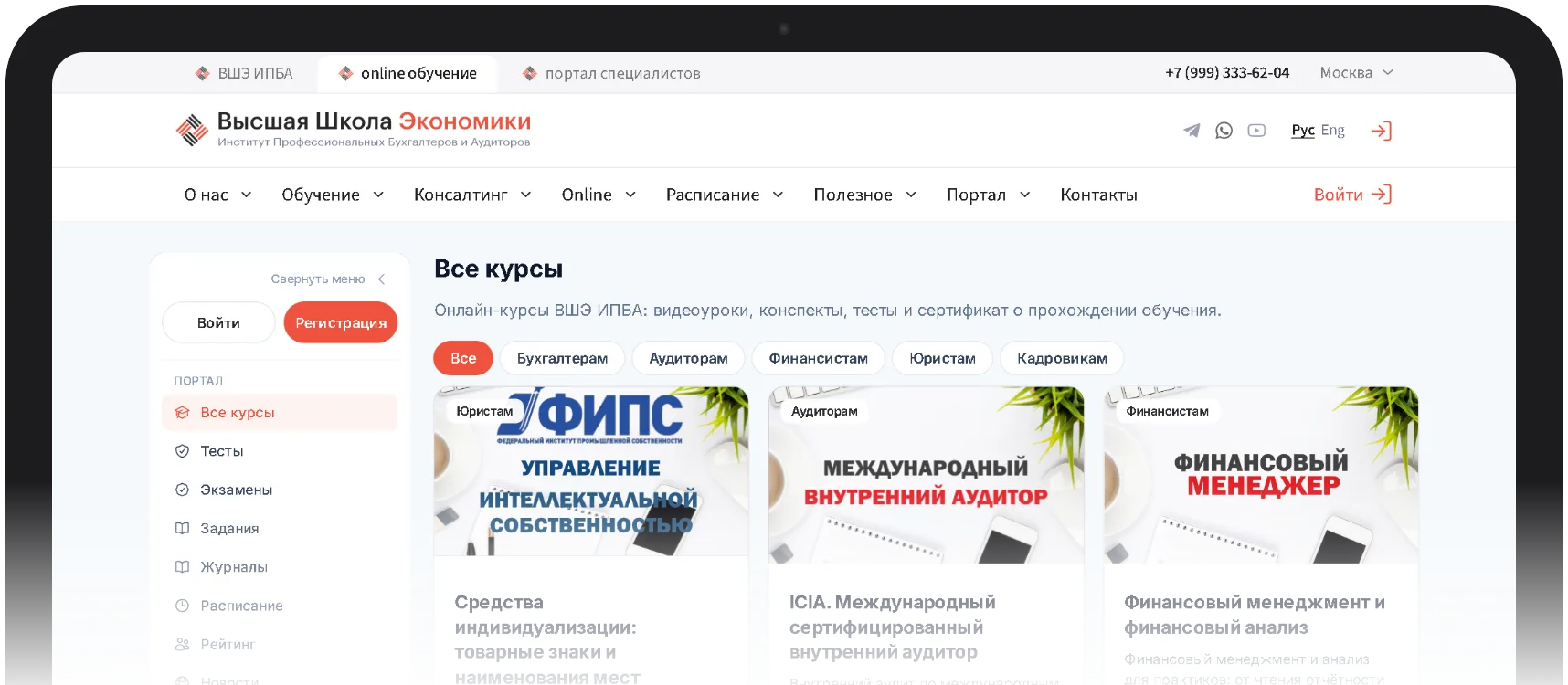
A convenient learning platform
A personal account with a clear interface: manage your training, track your progress and communicate with instructors in one place.
Training materials
All lectures, presentations and assignments in one place
Class schedule
A calendar with reminders of upcoming classes
Progress
Progress and completed assignments
Video lectures
Watch lectures at a convenient time
FAQ
Frequently asked questions about the Trademarks service
Didn't find an answer? Ask a question — a manager will reply and help you choose a program.
Ask a question01 What does the Trademarks service include?
The scope of work is determined after analysing the client's task. We agree on the stages, expected result, timing and list of required documents, and then record them in the proposal.
02 Who is this service suitable for?
The service suits companies and entrepreneurs that need professional support in the "Trademarks" area without expanding their own team.
03 How is the project work organised?
Work begins with a consultation and diagnostics. We then draw up a plan, assign responsible specialists, carry out the agreed stages and deliver the results to the client.
04 What do timelines and cost depend on?
Timing and cost depend on the scope of work, the condition of the source data, the complexity of the task and the required depth of support. Exact terms are determined after an initial assessment.
05 How is confidentiality ensured?
The client's information and documents are used only to carry out the agreed work. Access to them is granted to the specialists directly involved in the project.
About the “Trademarks” service
Trademark Registration
The most important thing a company gets from registering a trademark is a guarantee that its money is safe. Every entrepreneur invests in promoting their brand. They pay for advertising and for promotion in search engines and social networks, design packaging and order promotional materials from a printing house. The brand becomes recognisable.
If a brand is not registered, anyone can register the trademark in their own name. And this is not only about competitors and firms from other regions. There are so-called patent trolls: people who look for unregistered brands, register them in their own name and demand money from business owners for the right to keep using the trademark – their own name.
Trademark registration gives a number of further advantages:
- the company's profit grows as the brand becomes recognisable;
- it can receive royalties from the use of the trademark under a licence;
- it can sell a franchise;
- it can obtain compensation from infringers through the courts (believe us, they will turn up in time);
- it becomes possible to start working with large retail chains;
- the brand can be made an intangible asset of the company, which will increase its value.
By law, registering a trademark is not mandatory. But without registration, business owners cannot be sure that the brand will still belong to them tomorrow, or that all the money invested in promotion will not pass to competitors or patent trolls.
Symbols denoting registered intellectual property:
© – a registered copyright object: a song, the text of a book, a computer programme, an article on a website, a drawing, a photograph – anything created by an author or a team of authors. The author does not have to be a legal entity. If you have created a work – written a quatrain or sketched a drawing on a napkin – it is already an object of your copyright.
® – a registered trademark: a logo, slogan, smell, name, packaging shape – anything by which users recognise your products and distinguish them from those of competitors.
™ – a trade mark. The same as a trademark, only abroad: in the USA, the United Kingdom, the EU and other countries. If you register a brand abroad, you will have a trade mark. In Russia – a trademark.
Types of trademarks
A firm can register any information by which users distinguish it from competitors. There are seven types of trademarks:
A word trademark is a name. It may be written in a distinctive font or without one. Even if you register your brand written in a distinctive font, another company will not be able to register it by writing it in a different colour or with letters of a different shape.
A figurative trademark is a company emblem. Images by which you are recognised. If you have registered an image as a trademark, no one else can put it on their products.
A combined trademark is, as a rule, a logo. Images with letters. A good option for those who always use the name together with the emblem. You can register a combined mark and save on separate registration of a figurative and a word trademark.
A three-dimensional trademark is most often packaging. Companies that have come up with a unique design for the packaging of their products register it so that competitors cannot release products in boxes, bottles and flasks of the same shape.
A colour trademark: if a firm has developed a unique colour for its products, it can also be registered.
A tactile trademark is registered by firms that make products for the blind and write the name and slogan in Braille.
A sound trademark is any melody by which customers recognise a brand.
If you have registered your trademark, another company has no right to use the same or a similar name.
A name as a trademark
If you are promoting a personal brand, you can register your own name as a trademark. Then no one will be able to carry out business activity under the same name. That is, if people are called the same as you according to their documents, they will continue to live under their own name. But to provide services in the field in which you already work, they will have to use a pseudonym.
For example, a psychologist registers her name "Galina Ivanova" as a trademark. From then on, all other Galina Ivanovas can live with this name and even work as employed psychologists. But they will not be able to run a private practice or a social media blog as psychologists under their own name, because they will receive a fine of up to 5 million roubles from the rights holder.
Trademark registration procedure
Registration of a mark takes about a year from the date of filing the application.
-
Search
Before filing an application, you check the trademark against the registers. There is a check against already registered marks and against those that have only just been filed. If you have invented a new word for the name of your firm and such a word does not exist, a check against already registered marks may be enough. But if you use ordinary words, not invented ones, it is better to order a full search from patent attorneys.
-
Selecting ICGS classes
As a rule, every business needs to register a trademark in several classes. For example, shops need to register the brand in all classes of the goods they sell. Sewing goods, food products and many others are also spread across several classes – you will have to register in all of them. If you do not yet carry out some activity but plan to, it is better to register that ICGS class for yourself in advance.
On the day you file the application for trademark registration, you acquire the right of priority. That is, if another company files an application to register the same brand tomorrow, it will be refused.
-
Examination
Specialists check the mark for identity and similarity with other brands that filed applications before you and with registered trademarks. If Rospatent finds similar marks, the money is not refunded.
-
Payment of the second part of the state fee
After your registration is approved. The cost includes registration of the mark in 5 classes.
-
Registration
Registration of your trademark: you must pay again for the issue of the registration certificate.
If no similar brands are found during the search, it is quite realistic to register a trademark yourself. The main thing is to correctly identify all the ICGS classes needed for your type of activity, fill in the documents and pay the state fee.
Remember that if you file an application for trademark registration in 3 classes at once, it will cost one amount. But if a company first files an application for registration in two classes and a month later decides to register the brand in one more – it will have to pay twice, since classes cannot be extended. You will have to file an application and pay for the procedure again.
Contact us and our specialists will help you register a trademark.
Not sure which program to choose?
Our specialists will help you choose a program for your goals and answer all your questions. The consultation is free!
Reach us in one click: call us.
+7 (727) 224-21-21
contact us via messengers


