 hseipaa.kz




Intellectual property
Disposal of rights and circulation of intellectual property assets
 2 programme modules
 Lectures and practical reviews
 Certificate of completion of the course
“Online” — go to online learning: find a course, buy it and start right away

0
What this course is about
The course is devoted to disposing of intellectual property rights and the legal regulation of the digital environment: computer programs, databases and information.

Contracts in the field of intellectual property

Legal regime of computer programs and databases

Information protection and the know-how regime
Knowledge and skills after the course
 Understanding the issues of disposing of personal non-property rights
Knowledge of current legislation on disposal of rights
Skill in drafting contracts in the field of intellectual property
Understanding an agreement on alienation of an exclusive right
Knowledge of the types and features of a licence agreement
Legal regulation of the creation and circulation of software
Mechanisms for protecting information, including the trade secret regime
Why this matters
In the information society, intellectual property objects are becoming a key asset of a company.

Computer programs
Equated with works of science and art, but subject to a special legal regime.

Databases
They make it possible to protect data sets, including those consisting of "raw" data.

Information as a commodity
Requires a competent choice between civil-law and information mechanisms.
Practical questions about the course
We analyse situations in which errors are most often made.

Mixing of contracts
A contract for the provision of information services and a licence agreement have different consequences.

Free licences
Specifics of applying open licences to software.

Pre-installed software
Rules for using software supplied together with equipment.

Know-how
The trade secret regime is not suitable for every kind of information.
Who the training is suitable for
For company lawyers
For patent attorneys
For IT companies and developers
For business leaders
For licensing specialists
For authors and right holders
For contract management specialists
Curriculum
The course consists of two modules: disposal of rights and civil law in the digital environment.

2
programme modules

5
topics on contracts

12
practical theses
- The problem of disposing of personal non-property rights and general provisions on the disposal of rights.
- Contract on alienation of the exclusive right, licence agreement: types, features and risks.
- Special legal regime, the scope of the rights of the right holder and the right to the integrity of the program.
- Two forms of protection — copyright and related rights — and how to combine them skilfully.
- Information services and the licence agreement, use of data in the cloud.
- The know-how regime and main contracts relating to information.
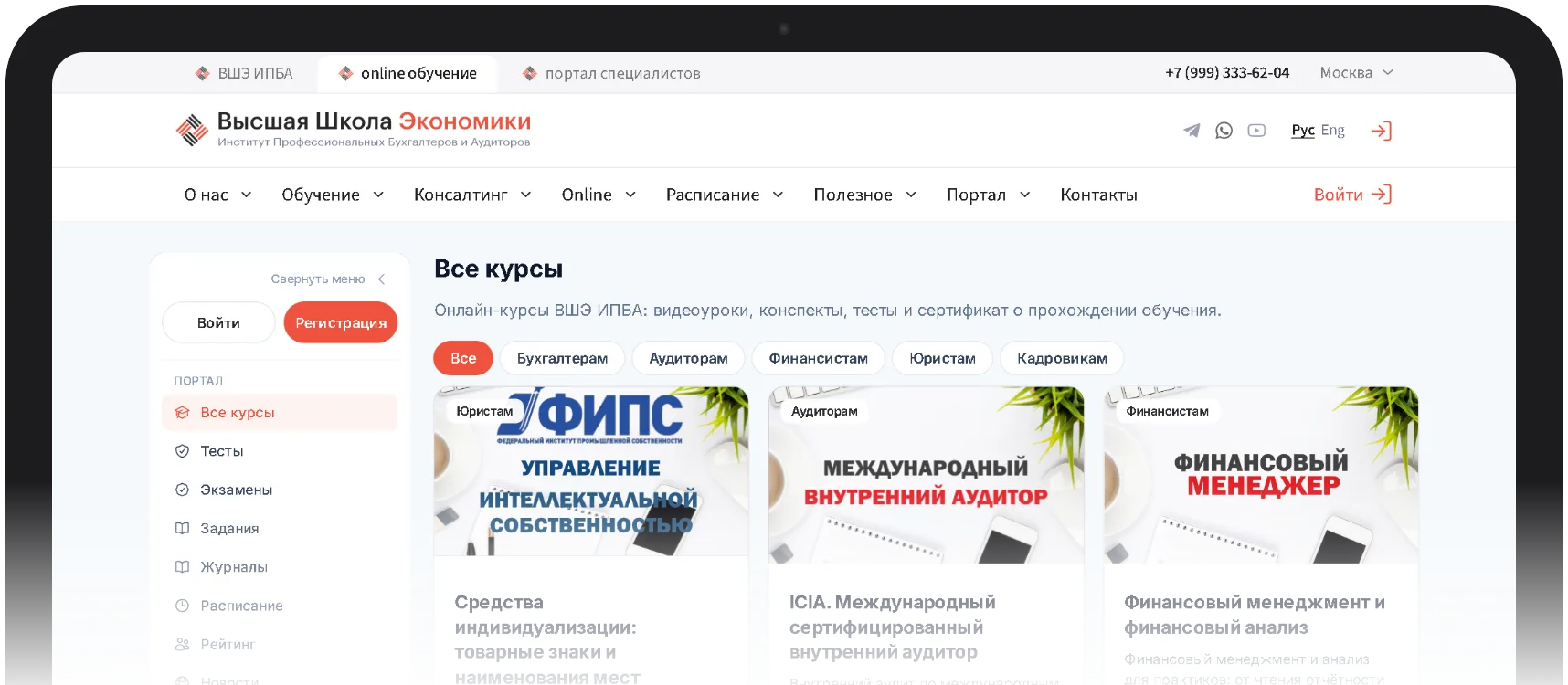
A convenient learning platform
A personal account with a clear interface: manage your training, track your progress and communicate with instructors in one place.
Training materials
All lectures, presentations and assignments in one place
Class schedule
A calendar with reminders of upcoming classes
Progress
Progress and completed assignments
Video lectures
Watch lectures at a convenient time
FAQ
Frequently asked questions about the "Intellectual Property" course
Didn't find an answer? Ask a question — a manager will reply and help you choose a program.
Ask a question01 Who is the "Intellectual Property" course suitable for?
The course is suitable for specialists who need to systematise their knowledge of “Intellectual Property”, improve their qualifications and apply new skills in their work.
02 What does the course programme include?
The programme covers the key requirements, professional tools and practical aspects of the course topic — disposal of rights and circulation of intellectual property objects.
03 Are practical classes included?
Yes. Theory is reinforced with practical assignments, examples and professional situations so that learners can apply their knowledge at work.
04 What are the duration and format of the training?
Format of training: 2 programme modules. Duration: Lectures and practical reviews.
05 What document is issued after the training?
After successful completion of the course, a Certificate of Course Completion is issued. The terms of the final assessment are communicated before classes begin.
About the “Intellectual property” program
Disposal of intellectual property rights
Participants' knowledge and skills after studying the module:
- Understanding the issues of disposing of personal non-property rights.
- Knowledge of current legislation on the disposal of rights.
- Understanding the specifics of drawing up contracts regarding the disposal of personal non-property rights
Lecture outline:
1. The problem of disposing of personal non-property rights.
2. General provisions on the disposal of rights.
3. The contract for the alienation of an exclusive right.
4. The licence agreement: types, features, risks...
5. Other contracts in the field of intellectual property.
Civil law in the digital environment: computer programs, databases, information
Participants' knowledge and skills after studying the module:
Knowledge of the current legislation on the legal regulation of the creation and circulation of software, databases and information, and of the procedure and specifics of its application.
Training plan for trademark registration Lecture outline:
1. Computer programs occupy a special place in civil law: being equated with works of science, literature and art, they have a specific regime that determines a particular scope of the rights holder's rights. In particular, it is worth noting that the legislation actually allows the author's right to the integrity of a program to be bypassed, giving the holder of the exclusive right to the program broad possibilities to modify it.
2. In an information society, databases are becoming increasingly important objects. In this regard, it is very important to take into account the specifics of their legal regulation. In essence, the database regime makes it possible to protect diverse arrays of information, including those consisting of "raw" data.
3. It is also important to bear in mind that Russian law provides two options for protecting databases: copyright and a special related right. With properly structured protection, it is possible to combine the advantages of each of these options.
4. Special attention should be paid to Article 1280 of the Civil Code of the Russian Federation, since it gives the owner of a copy of software or a database broad possibilities to use the intellectual property without concluding a licence agreement; this mechanism must be taken into account both by a potential user and by the rights holder.
5. The existence of a large number of cases of free use of computer programs and databases must also be taken into account by rights holders and users.
6. A contract with the rights holder may be used by the rights holder as a means of restricting the distribution of the information contained in the database.
7. Recently the problem of scraping – the automated extraction of information about a subject of interest from someone else's database – has become very topical. Court practice in this respect is highly contradictory, but certain guidelines can be pointed out for determining whether the actions taken are permissible.
8. Although the general rules on the disposal of rights in the field of intellectual property apply to computer programs and databases, there is also much that is distinctive here – from the possibility of concluding contracts in a simplified manner to special types of contracts (including "open" licences). The procedure for using pre-installed software also deserves special attention.
9. Information is not an object of civil law and, at the same time, acquires the character of a commodity. The Civil Code of the Russian Federation and the Law "On Information..." provide various possibilities for protecting information, but it is important to apply the existing mechanisms competently, understanding the differences in the consequences of using civil or information legislation.
10. To use information (including in the "cloud"), it is necessary to distinguish between two fundamentally different mechanisms: a contract for the provision of information services and a licence agreement. In practice they are often mixed up, but they have different conditions of application and different legal consequences.
11. An important mechanism by which information can be protected is the trade secret (know-how) regime. It is not suitable for every kind of information, but overall it provides fairly effective means of protecting it.
12. The main contracts used in relation to trade secrets are the well-known contract for the alienation of an exclusive right and the licence agreement. Nevertheless, there are many specifics here that lead to court disputes in practice.
Intellectual property
- Participants' knowledge and skills after studying the module:
- Knowledge of the current legal norms in the field of patent protection.
- Knowledge of the procedure for obtaining a patent.
Module description:
The module examines the legal aspects of intellectual property (registration, protection in different jurisdictions, etc.), especially in the area of developing and protecting code / algorithms.
Copyright in the modern world: new opportunities and new dangers
Participants' knowledge and skills after studying the module:
- Knowledge of the current legislative requirements in the field of copyright.
- Knowledge of the specifics of concluding contracts in the field of copyright.
Lecture outline:
1. General provisions on copyright.
2. Specifics of using copyright objects in digital form.
3. Specifics of using copyright objects in information and telecommunication networks.
4. Specifics of protecting computer programs, databases and artificial intelligence products.
5. Contracts in the field of copyright.
Digital rights
Participants' knowledge and skills after studying the module:
Knowledge of the existing regulatory framework in the field of digital rights and trends in its development.
Module description:
Without understanding the principles of the digital era it is hard to work as a lawyer even today, let alone in the future. The digital world gives rise to many new problems and challenges that lawyers will have to solve and regulate. In this module you will be introduced to a number of these problems and challenges.
Not sure which program to choose?
Our specialists will help you choose a program for your goals and answer all your questions. The consultation is free!
Reach us in one click: call us.
+7 (727) 224-21-21
contact us via messengers


